Trees and power lines can share a street for decades, yet it only takes one storm, one fast growth season, or one poor pruning cut to turn that partnership into a hazard. Clearing conductors is not about giving a tree a haircut. It is a blend of biology, electrical safety, legal duty, and long‑range planning. The work rewards precision. Done well, it nudges a tree’s crown to grow away from energized lines, keeps service reliable, and preserves the tree’s health and form. Done poorly, it guarantees faster regrowth, repeat callouts, and a tree that decays from the inside.
Why this matters
Utility outages and arc faults almost always tie back to contact or near contact. A wet branch can conduct at surprising distances, especially on coastal days when salt spray lingers in the air. Squirrels and crows bridge phases with nests and dropped wires. Trees do not need to touch a line to cause trouble. Add wind, ice load, or summer convective storms, and a limb with 12 months of unchecked growth becomes a feeder for voltage tracking. Crews like mine see this weekly during the late summer and again after the first heavy snow.
On the people side, the stakes are simple. You want your home to have reliable power and your trees to retain their structure and value. Pruning and crown shaping for conductor clearance can honor both goals if you understand how the tree will respond over the next five years, not just the next five weeks.
Clearances are not guesses
Every utility maintains clearance targets by voltage class, species, and growth rates. The numbers vary by jurisdiction, but here is the real‑world pattern we plan to:
- Primary distribution lines, often 4 kV to 25 kV, typically need 8 to 15 feet of clearance after pruning. In fast growth corridors, we aim for 12 to 20 feet to build in a margin for two to three seasons of regrowth. Secondary and service drops to a home require less clearance, often 3 to 6 feet, but that depends on insulation type and local code. Many service drops are weather‑resistant but not touch‑safe. Transmission lines demand much more distance, set by utility standards and national codes. Arborists working under these spans coordinate with utility vegetation managers and often rely on specialized equipment.
We layer in growth data. Silver maples and willows in fertile river soils can put on 4 to 8 feet per year. Slower species like white oak might add 1 to 2 feet. If the utility prunes on a three‑year cycle, we build clearances wide enough that the canopy will not encroach until just before the next cycle. This avoids the yo‑yo of annual cuts that stress the tree.
Directional pruning beats topping every time
Topping looks fast and decisive. It also sets up a decade of problems. The tree responds to a topped cut with a flush of watersprouts, fast vertical shoots attached with poor structure. Decay accelerates from the large, exposed stubs. The crown loses its ability to shed wind, so it fails low and hard during storms.
Directional pruning is our standard tool near power lines. The method chooses specific laterals to carry growth away from the conductors and removes competing leaders that want to fill the wire zone. Cuts are made back to a live lateral at least one third the diameter of the removed limb. The tree closes wounds more efficiently and keeps a natural outline. It also pushes its energy where we want it, away from energized space.
Crown reduction has a place when a dominant leader grows directly into a conductor corridor and no lateral can take the lead. The reduction cut lowers the height of the leader to a lateral that can assume terminal growth. We use it sparingly, especially on species like beech and birch that resent heavy reduction. Crown thinning can help when sail effect is a risk, but it is easy to overdo. Too much interior removal sunburns bark and starves the tree. The simplest rule still holds: remove only what you must to achieve safe clearance and future‑proof the growth path.
Timing matters more than most people think
Trees are not machines. They respond to cuts based on stored energy, sap flow, and weather. The safest calendar for clearance work depends on your climate and species mix.
- In cold climates, structural work on hardwoods often lands in mid to late winter when the tree is dormant and wounds close predictably in spring. We avoid pruning during extreme cold snaps that can shatter brittle wood. In warm, arid regions, summer pruning on some species reduces water stress by balancing canopy with root supply. On desert natives, heavy winter cuts can backfire and invite dieback. Spring flush is a poor time for major reductions on many species. The tree is spending reserves to push leaves, and heavy cuts then can set back health for the season. For conifers, late winter to early spring catches them before active growth. Pines and firs tolerates reduction poorly. We manage conifers near lines primarily with directional cuts and long‑term replacements.
Wildlife considerations shape timing too. Nesting windows for birds and bats are protected in many jurisdictions. We train crews to survey each tree and stand down when nests are active, except during Emergency Tree Services when public safety is at risk.
The work zone near energized lines is its own world
No homeowner and no unqualified contractor should prune or remove branches within the minimum approach distance to live conductors. That distance changes with voltage, weather, and training level. A certified line‑clearance arborist understands when to isolate lines, how to ground where required, and how to position rigging so a cut limb cannot pendulum into a conductor.
On municipal projects, we coordinate with the utility to de‑energize or cover lines with line hose when possible. Cover is not insulation for direct contact. It is a secondary safeguard, and it can shift as limbs move. We treat all lines as energized unless the utility verifies otherwise.
Rope handling matters. We keep rigging lines, throw lines, and even harness lanyards away from lines with wide buffers. Wet rope conducts. I have seen green loggers underestimate a cable drop and find their bull rope bridged across phases by a falling limb. The rope burned in an instant. We were lucky no one else did. Respect for energized space is non‑negotiable.
Anatomy of a good clearance plan
A strong plan begins on the ground with a clear picture of the tree’s architecture and the line’s path. On a mature red oak that leans 10 degrees toward the street, for example, the primary is three feet inside the outer crown on the south side. The service drop dips through the north quadrant. Rather than whacking a tunnel through the center, we reduce the southern leaders with well‑placed lateral cuts, lighten the outer tips facing the conductors, and selectively remove two interior uprights that threaten to refill the wire zone. We leave the northeast quadrant alone to preserve photosynthetic area, balance the tree’s center of gravity, and keep overall vigor high.
We map likely regrowth. On fast species, we favor cuts that shorten internode length around the wire zone, not just remove current length. That means finding laterals arising from nodes with smaller bud clusters, which slows the next season’s elongation. On slower species, we plan lighter cuts with longer return intervals.
We also account for utility work cycles. If the utility is on a three‑year cycle, pushing the tree to a five‑year plan is unrealistic. Cuts should anticipate the next visit, not fight it. Cooperation between private Tree Pruning & Crown Shaping crews and utility vegetation managers yields better outcomes than dueling saws.
Safety audits and Dangerous Tree Assessment and Removal
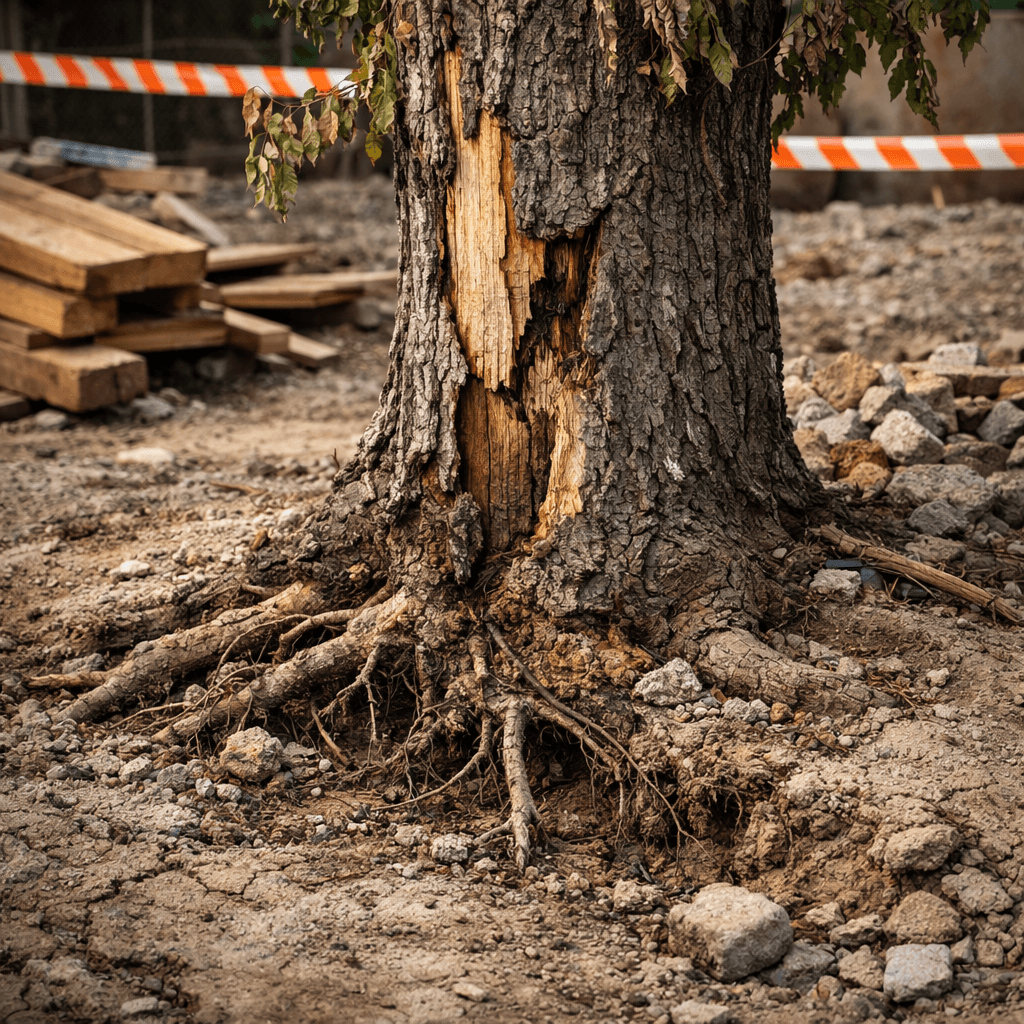
Sometimes no amount of pruning can make a tree safe near power lines. The boom truck test tells part of the story. If the only way to clear a primary is to cut through a trunk with advanced decay, you do not have a pruning job, you have a removal. Dangerous Tree Assessment and Removal starts with objective signs: fungal conks, cavities exceeding one third of stem diameter, root buttress decay, progressive lean with soil heaving, or included bark unions loaded over a conductor.
We combine sounding, resistance drilling where appropriate, and crown movement observation on windy days. If the risk matrix shows high likelihood and high consequence, we move to Tree Removal Services. On removals near live conductors, we often dismantle top down with rigging to avoid swings. Coordination with the utility to drop a service for a few hours can make or break safety. When the stump remains, Stump Removal & Grinding cleans up the site and prevents trip hazards, and it also discourages resprouting on species like cottonwood.
Crown shaping without gutting the tree
Shaping for aesthetics while building a safe power corridor takes restraint. A mature canopy looks right because it has a rhythm formed over decades. You can maintain that rhythm while tightening the south face by 12 feet. We keep reduction cuts spread across the face rather than carving a vertical wall. From the street below, the human eye reads the soft curves as natural. From the conductor’s side, the utility sees daylight.
A trick we use on borderline cases is staged reduction. On a large sugar maple six feet off a three‑phase line, we scheduled two sessions six months apart. The first removed about 15 percent of the live crown, biased to the wire zone, and a few crossing branches that would later interfere with good reduction points. The second refined the structure and added another 5 to 10 percent reduction. The tree kept vigor, callused well, and the owner never felt the shock of a single drastic cut.
Tools that respect both tree and line
Sharp hand saws make the cleanest cuts, and we use them more than most people expect. On big laterals, a modern battery top‑handle saw gives precision without fumes at eye level. Pole pruners are a friend until they drift near a line. We carry non‑conductive poles rated for utility work and still treat them with caution.
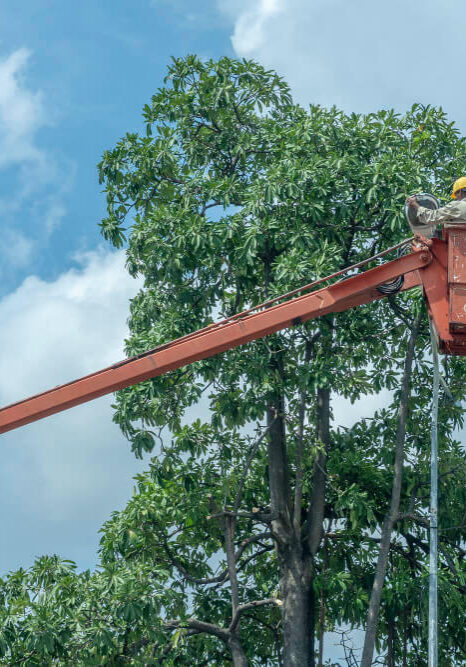
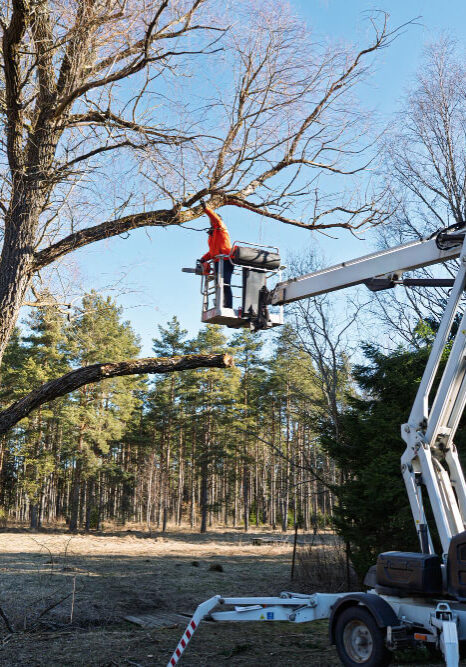
Rigging decisions affect conductor safety. When we cannot guarantee a limb will miss the wire, we set pull lines and redirect blocks so the load travels away from the hazard. If a limb must swing, it swings to open road space with spotters controlling traffic. In tight alleys with service drops laced like spaghetti, we prefer piecing out by hand from a bucket with the line covered and the utility notified.
When cable and bracing help, and when they mislead
Tree Cable and Bracing can stabilize a split union above a conductor corridor. The goal is to share load between stems and limit fissure propagation. I have installed dynamic systems on big maples that kept them standing through three ice events while we gently reshaped the crown away from the lines. But cables are not shields. They do not excuse overlong levers over a primary. If a leader extends above a line with an included union, add a cable only after you remove enough lever arm and weight to solve the underlying problem. Hardware must be inspected yearly. Old static systems hidden in foliage can fail and cause worse outcomes than doing nothing.
FireSmart thinking for utility corridors
FireSmart Tree Services overlap with utility clearance in dry regions. Ladder fuels, dense understories, and resinous conifer branches near conductors combine into a fine fuel matrix that catches ember showers. We prune lower conifer limbs up to a set height, often 6 to 10 feet depending on tree size, reduce heavy deadwood, and maintain horizontal separation from conductors. Where a corridor crosses a slope facing prevailing winds, we pay special attention to spacing crowns so a fire cannot race from tree to tree. Clearance work is not only about outages. It can break a fire path that would otherwise head for homes.
The role of a Certified Arborist Consultation
Before saws start, a Certified Arborist Consultation helps the homeowner and the utility speak the same language. We translate standards, weigh species response, and set a plan that preserves the tree’s value. The consult often discovers alternatives. For instance, relocating a service drop two studs to the east may be cheaper over ten years than forcing a handsome oak into a lifetime of hard reductions. On new builds, we steer planting plans so the mature crown will not reach the lines at all. Right tree, right place avoids future trimming and preserves street character.
A quick homeowner checklist before clearance work
- Photograph current conditions from several angles to document wire proximity and tree form. Call your utility and verify who is responsible for line clearance on your section of line, primary versus service. Ask for credentials and request a plan using directional pruning, not topping. Confirm how debris will be handled and whether Stump Removal & Grinding is needed if removal is likely. Schedule outside of peak nesting windows when possible, unless Emergency Tree Services require immediate action.
What happens on the day, step by step with the utility
- The crew conducts a job briefing, reviews voltage class, sets approach distances, and assigns roles. Utility coordination confirms status of the line, de‑energized or covered, and establishes radio or phone contact. Rigging and drop zones are set. Traffic control goes in if the street is affected. Pruning proceeds from outer tips inward, removing hazards first, then fine‑tuning structure and clearance. A final walk‑around verifies clearances, wound quality, and wire protection, then the site is cleaned and photos logged.
Common mistakes and how to avoid them
Over‑thinning. A tree that is pruned like a feather duster looks tidy for a month, then bakes in the sun and hustles to grow what it lost. The rush growth is weakly attached and points straight back at the wire corridor. Keep interior foliage that feeds the branch you left.
Ignoring growth direction. Cutting everything to a uniform height near lines feels neat but fails fast in practice. If you leave laterals that point toward conductors, they will refill the gap. Choose branches that point away and honor them.
Working hot without training. No video can make you a line‑clearance arborist. The physics of swing, the behavior of wind gusts through a cut face, the nuance of conductor sag on hot afternoons, these are not academic. If you are not qualified, do not work within approach https://acetree.ca/services/ distances. Call professionals.
One and done thinking. A single heavy prune will not buy 10 years for a fast species. Plan cycles. Set reminders. Small cuts on time cost less than emergency callouts and damaged crowns.
When removal becomes the smart choice
As trees crowd lines and reductions grow heavier each cycle, there is a point where the tree no longer has a dignified future in that spot. We talk through honest numbers. If a willow two feet from a primary grows 6 feet per year and the utility trims on a three‑year cycle, you are looking at 18 feet of regrowth by the next visit. That means deep, repeated reductions until the crown becomes a stub factory. The better path is Tree Removal Services now, removal of the stump, and a replant with the right species in a better place. Stump Removal & Grinding clears the deck for replanting, and the next tree can be a power‑line friendly species that tops out below conductor height or carries a naturally narrow crown.
Dealing with storms and sudden hazards
Storms do not respect calendars. When branches fall on or near lines, do not touch them. Even if a limb lies on a line quietly, voltage can travel through the wood to adjacent fences, wet ground, or your aluminum ladder. Emergency Tree Services prioritize making the scene safe. We coordinate with the utility to kill power and ground as needed. After clearance, we stabilize the remaining crown and schedule follow‑up pruning once the immediate hazard is mitigated.
We also see post‑storm opportunists knocking on doors. Be cautious. A low bid without credentials near energized lines is a risk you do not need. Ask for insurance, training, and references. A reputable crew will show them before you ask.
Costs and trade‑offs
Prices vary by region, access, and complexity. Pruning for conductor clearance on a mid‑size maple accessible by bucket might run a few hundred to a couple thousand dollars depending on scope. Complex work over tight alleys, backyard access only, or coordination with road closures can bring costs into the mid‑thousands. Removals near lines trend higher due to time and risk. Cable and bracing adds hardware and inspection costs. Where budgets are tight, staged work paired with a long‑term plan can keep a tree safe and a bill manageable. Investing in a Certified Arborist Consultation up front often saves money by focusing work where it counts.
Aftercare that pays off
After pruning, the tree invests in wound closure and resets its energy balance. Water in drought, mulch correctly, and avoid soil compaction near the root zone. Do not fertilize by default. If a soil test shows deficiencies, targeted nutrition helps. Otherwise, nitrogen dumps push fast, weak regrowth, exactly what you are trying to avoid near lines.
We also schedule follow‑up inspections. On fast growers, a quick summer pass to remove a few vigorous shoots aimed at the wire zone can extend the interval to the next major prune by a full year. This light touch costs little and keeps the structure disciplined.
Planting for the next forty years
The smartest clearance work starts before the shovel breaks ground. Under distribution lines, choose species that mature below 20 to 25 feet, or that naturally carry a narrow form. Serviceberry, Amur maple in appropriate zones, or columnar cultivars of hornbeam do well under many lines. Keep larger shade trees well back. Ten feet from the sidewalk looks generous when a sapling arrives. Thirty years later it is a forced compromise. Place big trees 25 to 35 feet from conductors and prune while young to direct leaders away.
Where you inherit a bad placement, consider relocation of the service drop or conversion to underground if the utility offers it. These projects carry costs, but in neighborhoods where canopy matters, they pay back in property value and reduced maintenance.
Bringing it all together
Pruning and crown shaping to clear power lines demands a steady hand and a long view. The work respects both electricity and biology. It keeps neighborhoods lit during storms and keeps trees sound through decades. Some jobs ask for surgical restraint, others for decisive removal and a replant with a smarter species. Along the way, tools like Tree Cable and Bracing, FireSmart Tree Services, and Dangerous Tree Assessment and Removal fit as part of a bigger plan, not as stand‑alone fixes. A Certified Arborist Consultation brings all of this into focus.
If you are planning work near conductors, start with a conversation. Get clear on who owns which lines, what the cycles look like, and how your tree will respond over the next few seasons. Choose directional pruning over shortcuts. Think about where water runs, where wind hits, where birds nest, and where kids play. A good clearance job fades from memory because the lights stay on, the tree looks like it grew that way, and you do not hear another chainsaw for a few quiet years. That is the mark of craft in this trade, and it is what we aim for every time we roll a truck to the curb.
Ace Tree Services Ltd.
Name: Ace Tree Services Ltd.Address: 4656 Wallace Hill Road, Kelowna, BC
Postal code: V1W 4C2
Phone: 250-212-9593
Website: https://acetree.ca/
Hours:
Monday: 7:00 AM - 5:00 PM
Tuesday: 7:00 AM - 5:00 PM
Wednesday: 7:00 AM - 5:00 PM
Thursday: 7:00 AM - 5:00 PM
Friday: 7:00 AM - 5:00 PM
Saturday: 7:00 AM - 5:00 PM
Sunday: Closed
Open-location code (plus code): RHF8+8G Kelowna, British Columbia, Canada
Map/listing URL: https://www.google.com/maps/place/Ace+Tree+Services+Ltd./@49.8232606,-119.4337283,659m/data=!3m2!1e3!4b1!4m6!3m5!1s0x537d8b1d074815c5:0x450b88afa7a41435!8m2!3d49.8232606!4d-119.4337283!16s%2Fg%2F11ydkpnh22
Embed iframe:
"@context": "https://schema.org", "@type": "HomeAndConstructionBusiness", "name": "Ace Tree Services Ltd.", "url": "https://acetree.ca/", "telephone": "250-212-9593", "address": "@type": "PostalAddress", "streetAddress": "4656 Wallace Hill Road", "addressLocality": "Kelowna", "addressRegion": "BC", "addressCountry": "CA" , "openingHoursSpecification": [ "@type": "OpeningHoursSpecification", "dayOfWeek": "https://schema.org/Monday", "opens": "07:00", "closes": "17:00" , "@type": "OpeningHoursSpecification", "dayOfWeek": "https://schema.org/Tuesday", "opens": "07:00", "closes": "17:00" , "@type": "OpeningHoursSpecification", "dayOfWeek": "https://schema.org/Wednesday", "opens": "07:00", "closes": "17:00" , "@type": "OpeningHoursSpecification", "dayOfWeek": "https://schema.org/Thursday", "opens": "07:00", "closes": "17:00" , "@type": "OpeningHoursSpecification", "dayOfWeek": "https://schema.org/Friday", "opens": "07:00", "closes": "17:00" ], "geo": "@type": "GeoCoordinates", "latitude": 49.8232606, "longitude": -119.4337283 , "hasMap": "https://www.google.com/maps/place/Ace+Tree+Services+Ltd./@49.8232606,-119.4337283,659m/data=!3m2!1e3!4b1!4m6!3m5!1s0x537d8b1d074815c5:0x450b88afa7a41435!8m2!3d49.8232606!4d-119.4337283!16s%2Fg%2F11ydkpnh22"
Ace Tree Services Ltd. provides professional tree removal, pruning, stump grinding, emergency response, and arborist consultations for properties in Kelowna and across the Okanagan Valley.
The company works with homes, commercial properties, and municipal settings where tree work needs to be planned carefully around buildings, fences, driveways, landscaping, and other site constraints.
Based in Kelowna, the team is positioned to help nearby neighbourhoods and surrounding Okanagan communities with routine tree care and time-sensitive storm cleanup.
Customers looking for careful tree work often want a crew with certified arborist training, insurance, and a methodical approach to higher-risk removals.
Services also include dangerous tree assessment, cabling and bracing, and wildfire risk reduction tree work for properties that need longer-term planning.
To request a quote or discuss tree care options, call 250-212-9593 or visit https://acetree.ca/.
A public map listing is available to help customers confirm the business location and get directions before a site visit or estimate.
For Kelowna property owners who need pruning, removals, or emergency tree help, a local tree service can make it easier to schedule site-specific recommendations and cleanup.
Popular Questions About Ace Tree Services Ltd.
What services does Ace Tree Services Ltd. provide?Ace Tree Services Ltd. lists tree removal, stump removal and grinding, tree pruning and crown shaping, emergency tree service, arborist consultation, dangerous tree assessment and removal, cabling and bracing, and wildfire risk reduction tree work.
Who does Ace Tree Services Ltd. serve?
The company describes its work as serving homes, businesses, and municipalities in Kelowna and across the Okanagan Valley.
Is emergency tree help available?
Yes. Emergency service is listed for downed or uprooted trees, dangerous tree assessment, stabilization work, and branch cleanup. If a tree is near power lines, the safest first step is to stay clear and contact the utility provider before any tree work begins.
Do I always need a permit to remove a tree?
Not always. Permit requirements can depend on where the tree is located and whether it is near a creek, lake, steep slope, or another protected area. It is best to check local rules for the specific property before removal work starts.
How deep does stump grinding usually go?
Standard stump grinding is typically described as going about 6 to 12 inches below ground level, which is often enough for grass or surface landscaping. Deeper grinding may be possible when site plans call for it.
How much of a tree can be safely removed at one time?
That depends on the species, age, health, and structure of the tree. In practice, good pruning is usually about removing the right limbs for health, clearance, and structure rather than chasing a fixed percentage.
What are common signs that a tree may be dangerous?
Large dead limbs, visible cracks, a new lean, root damage, canopy dieback, or storm-related damage can all be warning signs. Trees near structures deserve extra attention when any of those issues appear.
What is cabling and bracing in tree care?
Cabling and bracing are support systems used to reduce the risk of failure in trees with structural weaknesses that may still be worth preserving. They are generally used to add support, not to replace good assessment and ongoing maintenance.
How do I contact Ace Tree Services Ltd.?
Call 250-212-9593.Website: https://acetree.ca/.
Landmarks Near Kelowna, BC
Downtown KelownaThe downtown core is a practical reference point for lakefront neighbourhoods, mixed-use streets, and central residential properties. If your property is near downtown, tree pruning, removals, and cleanup can be planned around tighter access and nearby structures.
Knox Mountain Park
This well-known park north of downtown is a recognizable landmark for nearby homes and hillside properties. If you are close to this area, ask about tree assessment, trimming, or removal work suited to sloped sites.
Mission Creek Greenway
The greenway runs through several parts of Kelowna and is a useful landmark for nearby residential areas. If your property borders or sits near this corridor, site-specific tree planning is especially important.
Pandosy Village
Pandosy is one of Kelowna’s most recognizable neighbourhoods and a common reference point for south-central properties. If you are nearby, request help for pruning, removals, or storm cleanup around homes and small commercial sites.
Rutland
Rutland is a major east Kelowna neighbourhood with a mix of residential and local commercial properties. If you are located in or near Rutland, tree work can be scheduled for both routine maintenance and urgent situations.
Landmark District
This central business-focused area is a practical landmark for offices, service properties, and nearby residential streets. If your site is near the district, ask about careful tree work around parking, access lanes, and built-up lots.
Kelowna’s North End
The North End sits on the edge of downtown and is a useful reference for nearby homes, industrial sites, and commercial properties. If you are in this part of the city, request tree care based on the layout and constraints of the lot.
Airport District
The Airport District is a recognizable north Kelowna reference point for surrounding properties and access routes. If you are in this area, ask about tree services for residential acreage, commercial sites, or roadside cleanup needs.
Glenmore & Dilworth
These established Kelowna neighbourhoods are useful landmarks for central and north-central service calls. If your property is nearby, pruning and removal work can be tailored to mature trees and established landscapes.
Highway 97 Corridor
Highway 97 is one of the city’s main travel routes and a common way to describe location within Kelowna. If your home or property is just off the corridor, a clear landmark reference can help speed up quote scheduling and site planning.